
If indeed we want the board to manage the RBI, probably the government should take a close look at the US Federal Reserve system which has a two-part structure - a central authority in Washington, DC, and a decentralised network of 12 Federal Reserve Banks located throughout the country, says Tamal Bandyopadhyay.

Benchmark stock indices opened the week on a muted note on Monday, with the Sensex plunging nearly 483 points due to selling in IT, capital goods and banking shares amid losses in global equities. The Sensex tanked 482.61 points or 0.81 per cent to settle at 58,964.57. During the day, it tumbled 552.78 points or 0.92 per cent to 58,894.40. The 50-issue Nifty declined by 109.40 points or 0.62 per cent to finish at 17,674.95 as 29 of its stocks declined.

Fundraising activity in the debt market is gaining momentum ahead of the festival season. Several non-banking financial companies (NBFCs) and the National Bank for Agriculture and Rural Development (Nabard) are planning to raise at least Rs 5,560 crore in the next two days by issuing bonds, with a greenshoe size of Rs 6,370 crore. Ajay Malglunia, managing director and head of investment grade group at JM Financial, said, "The market likes certainty, the market will gain clarity after the US Federal Reserve's (Fed's) policy.
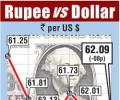
The partially convertible rupee closed at 62.09/10 per dollar compared with Tuesday close of 62.01/02, a fifth day of losses out of six.

Federal Reserve's move has thrown financial markets into a spin.
The central bank also asserted that the country is ready for the tapering of the US Federal Reserve's bond purchases.

Yellen is currently Vice Chairman of the Board of Governors of the Federal Reserve System.
The 30-share Sensex ended down 151 points at 20,709 and the 50-share Nifty ended down 51 points at 6,167.

'Das is friendly, but he finally does what he does. The quality of engagement is very good.'
He also feels that the govt should hike diesel and petrol rates.

The Financial Stability and Development Council members include heads of regulatory bodies like RBI, Sebi and Insurance Regulatory Development Authority.

The Reserve Bank of India's (RBI's) interest rate decision, West Asia conflict and trading activity of foreign investors are the key factors that will dictate investors' sentiment in the market this week, analysts said. Moreover, quarterly earnings from IT bellwether TCS, domestic macroeconomic data and movement in global oil benchmark Brent crude would also guide trends in the market. Worsening tensions in the Middle East and foreign fund outflows were the major culprits behind the equity markets sharp fall last week.

The US Federal Reserve on Wednesday (local time) raised interest rates by 75 basis points (bps) or three-quarters of a percentage point in the boldest move since 1994.
The Indian financial system is driven more by the domestic factors and "Fed rate cut is one of the triggers to review rates ", said Union Bank Bank of India chairman M V Nair.

Reserve Bank of India Governor Raghuram Rajan took charge of India's central bank when the rupee seemed to be in a tailspin while the country was facing runaway inflation.

India's foreign exchange reserves are at an all-time high.

Mint Road, on December 21, 2023, flagged the role of self-regulatory organisations (SROs) in strengthening the compliance culture in regulated entities (REs) and providing a consultative platform for policymaking. It also decided to issue an omnibus framework for SROs.
Indian economic growth hit a low of five per cent in the financial year ended March 31,2013 and further slowed in the first quarter of FY14.
For five consecutive policy reviews in 2023, the Reserve Bank of India (RBI) chose to hold rates, citing inflation threat. And when the prices did cool off a bit, it reminded all about the target to get the headline consumer price inflation at 4 per cent and the risks from food inflation. Heading into the new year, all eyes are on when RBI will cut the rates, especially after one of the Monetary Policy Committee (MPC) members stressed on the need for such an action in the face of the US Federal Reserve's guidance for easing rates.

The fall in reserves was due to a sharp fall in foreign currency assets.

'The government is trying to kickstart the investment cycle in India and while the corporate investments are yet to gather momentum, there are early signs of the same.'
The new Guv needs to focus on structural inflation problems.

IndusInd Bank was the top gainer in the Sensex pack, spurting over 8 per cent, followed by Axis Bank, ICIC Bank, Sun Pharma, SBI and Kotak Bank.

The rupee had ended lower by 19 paise at 56.15 against the dollar on wednesday as importers bought dollars in late trade.

Global investors have been cautious this year to put money into Indian real estate, as private equity inflow is down 44 per cent till December 12 to $3 billion compared to the entire previous year, according to Knight Frank. Real estate consultant Knight Frank India on Thursday released its data showing that the Indian real estate market received $3,024 million in PE investments from 23 deals between January 1 and December 12 this year, as against $5,357 million recorded in 2022.

'India's fundamentals are a lot better (than those of other emerging market economies).' 'India will suffer (witness a fall in its stock market) what I call the second order effect.' 'And the second order will happen when these funds (belonging to macro and hedge fund investors and which have leveraged Japanese yen-carry trades), because they lose money elsewhere as lot of their positions were financed by borrowing Japanese yen, will have to book profits in investment destinations where they are making money, including in markets like India.' 'They (these investors) will have to effectively sell in countries like India and which is the consequence (the crash in equity markets) that Indian markets might see.'

The comment was in response to a June 19 Reuters story citing sources with knowledge of the matter as saying that India planned to clear some oil payments to Iran through the United Arab Emirates central bank.

Among the Sensex firms, IndusInd Bank, Tata Steel, Tata Motors, Sun Pharma, Infosys, Mahindra & Mahindra, Infosys, NTPC, Bharti Airtel, HCL Technologies and Axis Bank were the biggest gainers. Tech Mahindra and Bajaj Finance were the laggards.
After trading hours, the government said the June-quarter current account deficit widened to $21.8 billion from $18.1 billion in the previous quarter.

'A 10 to 15 per cent allocation to gold in portfolios reduces risk without compromising on potential returns.'

Sensex witnessed the biggest single day gain since May 2009 in absolute terms.
He takes over at Mint Road at a time when the governor's job is even less easy than it is normally.

What the reserves offer for now is improved import coverage of about 13 months, almost double the 2013 level of less than seven months. And, ammunition to arrest a rapid rupee slide, says Anup Roy.

Equity investors will track the trading activity of foreign investors, global trends and ongoing earnings results for further cues, and benchmark indices may continue to witness consolidation in a holiday-shortened week amid the monthly derivatives expiry, analysts said. Markets fell sharply last week amid massive foreign capital outflows and dismal Q2 earnings so far. Weakness in the markets might continue in the near term amid cautiousness among investors ahead of the US presidential election early next month, an expert said.
All eyes are on new Reserve Bank Governor Raghuram Rajan who will come out with his maiden monetary policy review on Friday amid conflicting demands for rate cut and an urgent need to contain inflation which soared to 6-month high of 6.1 per cent in August.

India is better prepared to deal with any further US Fed tapering, but the country needs to remain vigilant to face eventualities, Reserve Bank Governor Raghuram Rajan said.
'One way of doing this could be offering credit guarantee to the banks, say 10 per cent, for fresh loans given to micro, small and medium enterprises,' observes Tamal Bandyopadhyay.

In the backdrop of an over four-decade high inflation, the US Federal Open Market Committee has raised its key policy interest rate by 75 basis points to 2.25-2.50 per cent, anticipating that the increase in the interest rates will be "appropriate". Hiking interest rates typically cool demand in the economy, thereby putting a brake on the inflation rate. The US Federal Reserve in its June meeting too raised the interest rate by 75 basis points, which was the steepest hike since 1994.

The US Fed interest rate decision, domestic inflation data and global trends would be key driving factors in dictating movement in the market this week, as the Lok Sabha elections outcome and the RBI policy decision are behind us, analysts said. The past week was a roller-coaster ride for investors as markets swung sharply in both directions before closing with strong gains.

Among the Sensex firms, HDFC Bank emerged as the biggest loser, falling 4 per cent. JSW Steel, Reliance Industries, UltraTech Cement, Maruti, Tata Steel, Wipro, Tech Mahindra, Bharti Airtel and Larsen & Toubro were the other major laggards. Power Grid, Asian Paints, Sun Pharma, Axis Bank, NTPC, ITC and Infosys were among the gainers.
